

Partner at AKD Lawyers
Practice Areas: Personal Injury, Insurance Claims

Many drivers assume that once their car is repaired after an accident, the financial loss ends there. But even a perfectly repaired vehicle can lose significant market value. This drop is called diminished value, and it affects what your car is worth if you sell or trade it later.
In Louisiana, you can recover this loss under certain conditions. Understanding how it works can help you protect your rights and avoid leaving money unclaimed.
Understanding Diminished Value
Diminished value is the difference between your car’s market value before an accident and its value after professional repairs. Once a vehicle’s accident history appears on reports like Carfax, potential buyers often pay less for it even when it looks brand new.
This reduction in resale value isn’t just a theory. It happens every day at dealerships and auctions because accident records follow the vehicle for life. For example, a 2022 SUV worth $35,000 before a crash may only sell for $30,000 afterward. That $5,000 loss is a diminished value.
Accidents affect buyers’ confidence. Even with excellent repairs, many assume the car might have hidden damage, making it less desirable compared to similar models with a clean record.
The Three Types of Diminished Value Explained
There are three main categories of diminished value. Knowing the difference can help you understand what type of claim applies to your situation.
Immediate Diminished Value
This is the drop in your car’s value right after the accident but before repairs. It reflects the car’s worth when it’s damaged and undrivable. Insurers rarely pay for this type since it’s temporary.
Inherent Diminished Value
This is the most common and widely accepted form. It refers to the permanent loss in resale value that remains even after proper repairs. Buyers tend to avoid vehicles with an accident record, no matter how well they’re fixed.
Repair-Related Diminished Value
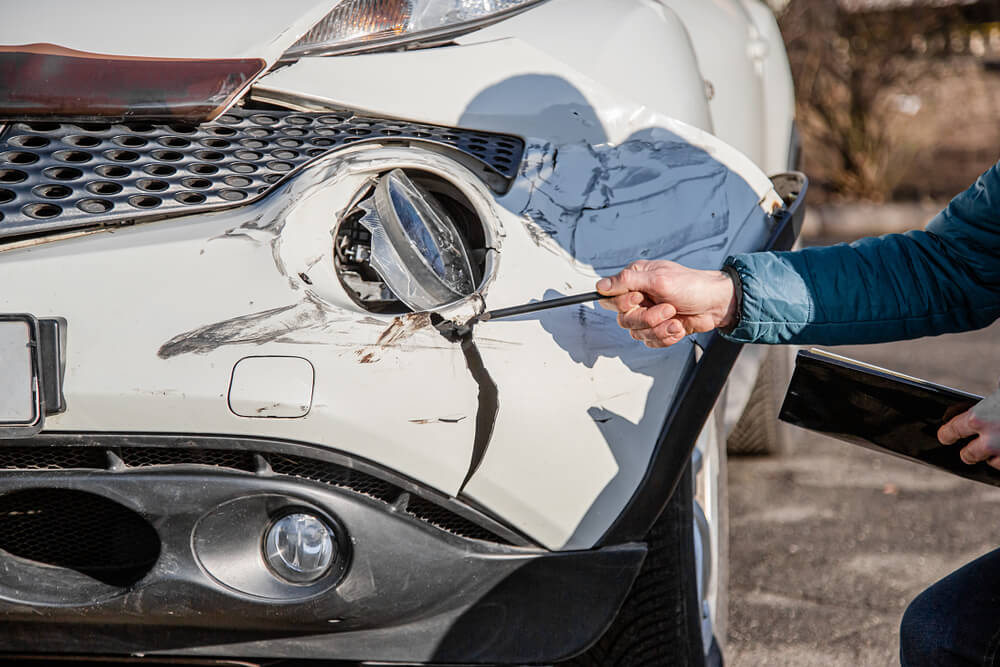
This occurs when the quality of repairs affects the car’s condition. Using aftermarket parts instead of OEM parts, visible paint differences, or minor alignment issues can all reduce a vehicle’s final market value.
“Even if your car looks flawless after repairs, using non-OEM parts or leaving behind small defects can lead to repair-related diminished value that lowers your car’s resale value.”
How Insurance Companies Calculate Diminished Value
Most insurance companies use a formula known as the 17c Formula to estimate diminished value. Although it’s a common approach, it often undervalues claims.
The 17c Formula Step-by-Step
- Determine pre-accident value: Usually based on Kelley Blue Book or NADA Guides.
- Apply a 10% base loss cap: Insurers assume a maximum loss of 10% of the pre-accident value.
- Adjust for damage severity: Minor (0.25), moderate (0.50), or severe (1.00).
- Adjust for mileage: Older or high-mileage vehicles lose additional value.
Example:
If your car was worth $30,000 before the crash:
- Base loss = $3,000 (10%)
- Moderate damage multiplier (0.50) = $1,500
- High mileage deduction (0.80) = $1,200
- Final diminished value = $1,200
“The 17c Formula originated from a Georgia court case (State Farm v. Mabry, 2001). Louisiana law doesn’t require this formula, so actual market losses may be higher than what insurers calculate.”
Because of these limitations, many car owners choose an independent appraisal to get a fairer valuation. If the insurer’s calculation seems inaccurate, New Orleans car accident lawyers familiar with insurance claim disputes can help review documentation and guide you through the process of contesting an undervalued offer.

Louisiana Law on Diminished Value Claims
In Louisiana, you have the right to seek diminished value compensation if you were not at fault. However, specific laws control how these claims work.
Comparative Fault Rule
Under Louisiana Civil Code Article 2323, compensation is reduced if you share fault for the accident. For example, if you’re found 20% responsible, your diminished value recovery is reduced by the same percentage.
Statute of Limitations
Louisiana has a one-year time limit for property damage claims, including diminished value. Waiting longer can cause your claim to be dismissed.
“According to Louisiana Civil Code Article 3492, property-damage claims must generally be filed within one year from the date of the accident.”
Who Can File a Diminished Value Claim
Only the not-at-fault driver can claim diminished value through the at-fault driver’s insurance. Your own insurer typically won’t pay unless your policy includes special coverage for it.
Steps to Estimate and File a Diminished Value Claim
Filing a claim involves more than just contacting the insurer. You’ll need evidence to support the actual loss.
|
Step |
What It Involves |
Why It Matters |
| Appraisal | Hire an independent vehicle appraiser | Establishes true post-accident loss |
| Documentation | Gather repair invoices, photos, value reports | Provides objective proof |
| Demand Letter | Submit to at-fault insurer | Starts official review |
| Negotiation | Compare insurer vs appraiser estimates | Ensures fair settlement |
| Legal Review | Optional if disagreement continues | Protects rights within time limit |
Insurers often start with lower offers, so having documentation from a credible appraiser strengthens your position.
Common Mistakes and Misconceptions
Many Louisiana drivers miss out on diminished value compensation simply because they don’t understand how it works.
Here are common mistakes to avoid:
- Believing repair costs are the only recoverable loss.
- Assuming insurance automatically includes diminished value.
- Waiting longer than one year to act.
- Forgetting to collect full documentation and photos.
Being proactive ensures your vehicle’s true worth is recognized.
FAQs
What qualifies as diminished value after a crash?
Diminished value is the measurable loss in your vehicle’s resale or trade-in worth after an accident, even when all repairs are properly completed and the car looks new.
Can I file a claim if I was partially at fault?
Yes. Louisiana’s comparative fault law allows partial recovery, but your compensation will be reduced according to your share of fault determined in the accident investigation.
Does my insurance cover diminished value?
Usually not. Standard auto policies exclude post-repair value loss unless you’ve added special diminished value or gap coverage as an extra protection on your insurance policy.
How can I prove diminished value?
You’ll need a professional appraisal, accurate repair invoices, market comparisons, and vehicle history documentation showing the difference between your car’s pre-accident and post-repair value.
What if the insurer’s offer is too low?
You can dispute the insurer’s valuation by submitting your independent appraisal, providing market evidence, negotiating further, or seeking legal advice before the one-year Louisiana filing deadline expires.
Conclusion: Knowing Your Vehicle’s True Worth
Diminished value is one of the most overlooked financial losses after an accident. Even if repairs are perfect, your vehicle’s resale value can drop significantly once its history is recorded.
By understanding how insurers calculate this loss and knowing Louisiana’s rules, you can make informed decisions and ensure you’re not leaving money unclaimed.
At Alvendia, Kelly & Demarest Law Firm, we help drivers throughout Louisiana understand their rights after an accident. If you believe your car has lost value due to someone else’s negligence, reach out today for a free consultation and learn how our team can guide you through the process.


Categories

In 2003, after being dissatisfied with the quality of legal care for victims of car accidents, Roderick ‘Rico’ Alvendia sought to establish a new firm focused on providing high-quality legal services to aid injured victims and their families. J. Bart Kelly, sharing Rico’s passion for upholding justice, joined the firm later that year, and established a partnership.